

Turning a Vintage Tablecloth Into a One-of-a-Kind Apron
Some old textiles are too interesting to throw away, but too worn to keep using for their original purpose.
This tablecloth was one of those pieces.
My mom owns an antique store and found it at an estate sale. It was marked as being from Czechoslovakia and came with a set of matching cloth napkins. The cream-colored fabric had woven blue stripes and a border that immediately felt worth preserving.
It was also clearly old.
Some areas were stained. Other parts had faded unevenly. It probably was not going back onto a dining table, but there was still plenty of usable fabric and character left in it.
We started trying to think of a way to give the whole set another useful life. I kept coming back to the idea of an apron.
Starting With the Material Instead of a Pattern
Most sewing projects begin with a pattern, followed by choosing fabric that works with it.
This project happened in the opposite order.
I already had the tablecloth, its matching napkins, and the basic vision in my head. I needed to create a pattern that would fit the textile rather than forcing the textile into a standard apron design.
That meant considering more than the overall size of the tablecloth. I also had to look at:
Where the stains and faded areas were located
Which parts of the woven stripes were still strong
How the original border could be preserved
How the matching napkins could become part of the design
Which areas would be most visible on the finished apron
The age and imperfections were not just problems to cut around. They helped determine the layout of the apron.
Developing an Original Apron Pattern
I made my own pattern based on the apron I was picturing.
The goal was a full apron with good coverage, a simple shape, long waist ties, and large pockets that would be useful in the kitchen, garden, or around the farm.
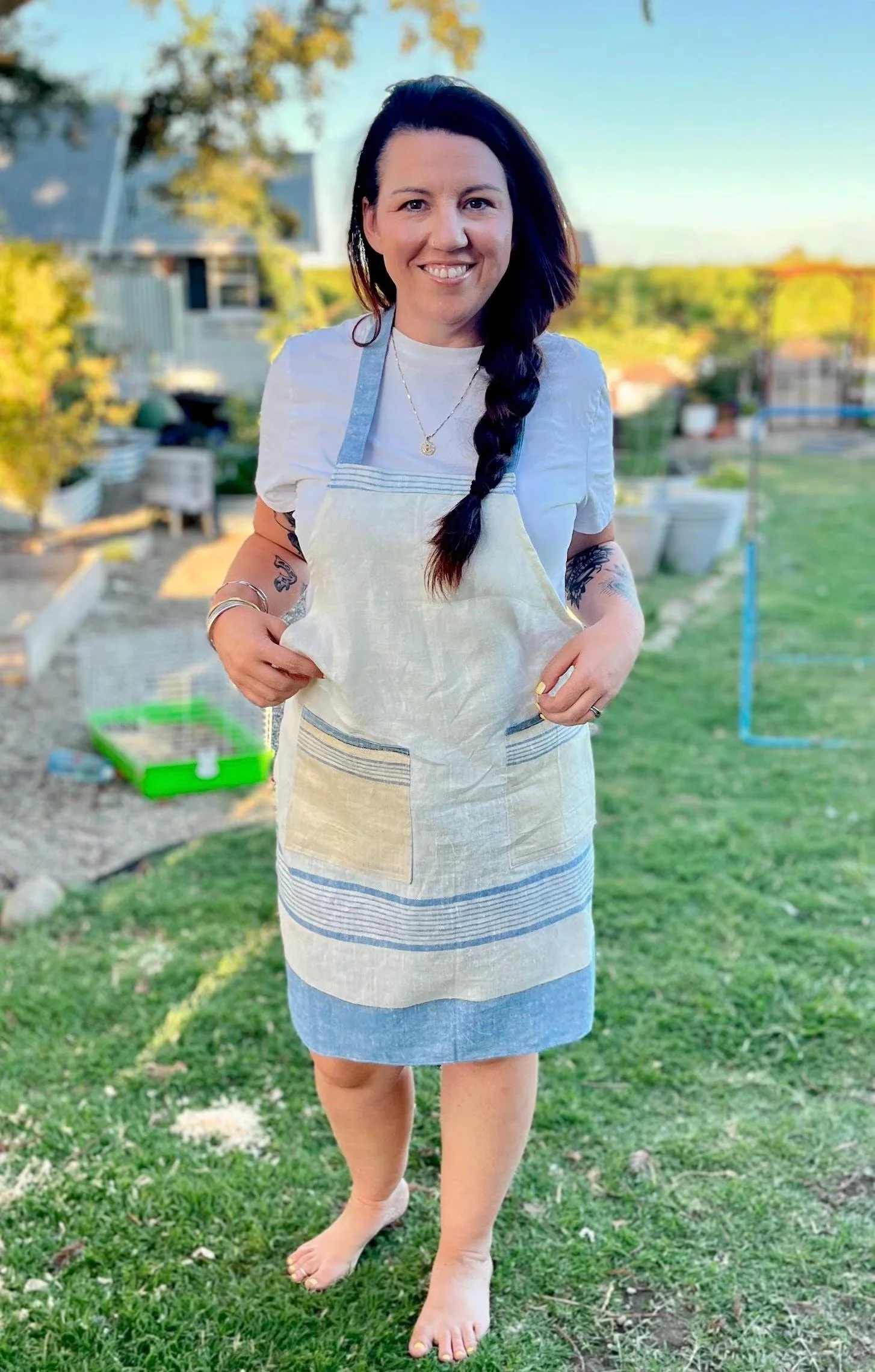
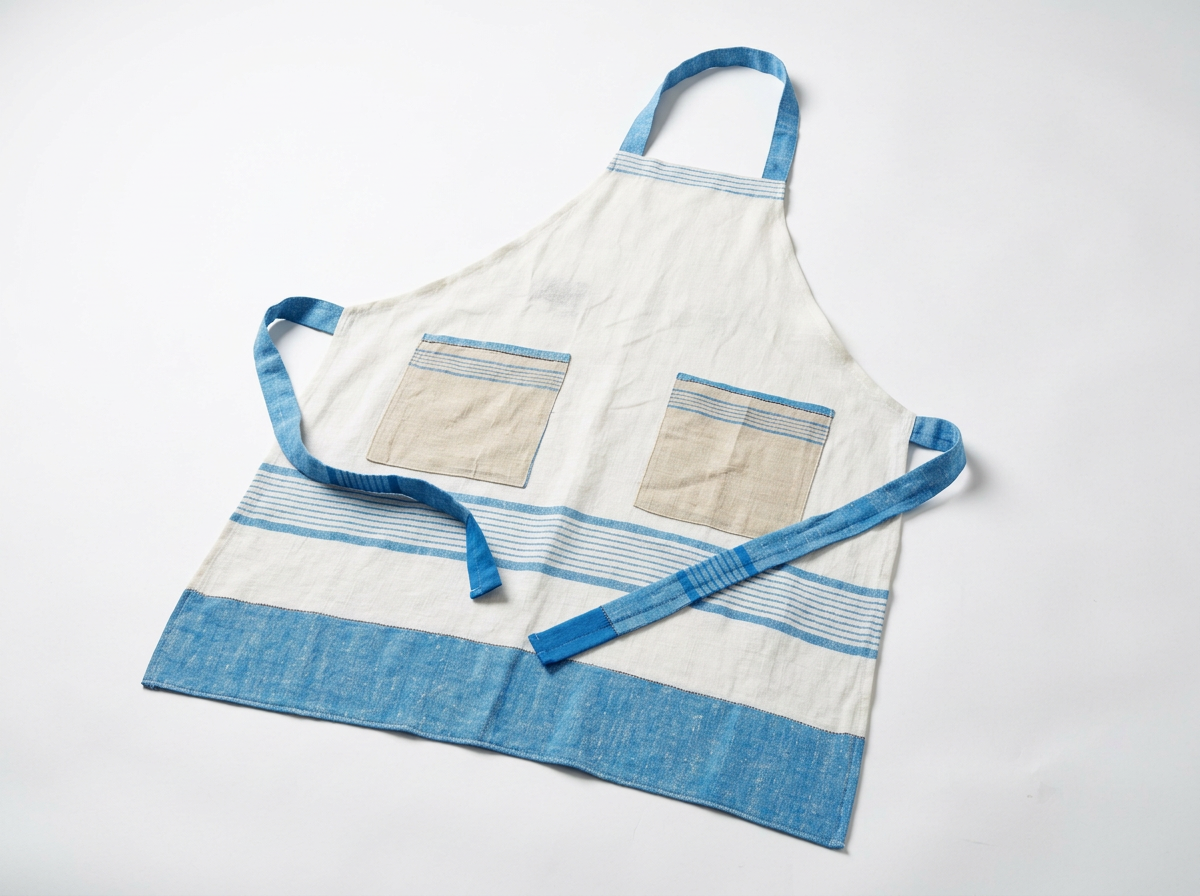
The tablecloth became the main body of the apron. Instead of separating the matching napkins from the project, I used them to create two oversized front pockets.
That choice helped keep the original textile set together in a new form. It also gave the apron pockets that were large enough to be genuinely useful rather than mostly decorative.
The stripe placement became an important part of the design. I worked the blue details into the bib, pockets, neck strap, waist ties, and lower portion of the apron so the finished piece would look intentional instead of simply cut from whatever sections were available.
Designing Around Stains and Fading
Working with reclaimed fabric requires a different mindset than cutting into new yardage.
You cannot assume every inch is usable. Before deciding where each pattern piece would go, I had to pay attention to the condition of the fabric and determine which imperfections could be avoided.
Some evidence of age is part of the appeal of an old textile. Softened fabric, slight variations in color, and small signs of previous use can give a finished piece character.
Large stains or badly weakened sections are different. Those areas either need to be cut away or placed somewhere they will not affect the finished item.
With a one-of-a-kind textile, layout decisions matter. Once a section is cut, there is no replacement yardage waiting at the fabric store.
Preserving What Made the Tablecloth Interesting
The goal was not to make the fabric look new.
It was to preserve the qualities that made the tablecloth worth saving in the first place.
The cream background and blue woven stripes have a simple, practical look. The finished apron feels a little like an old European farmhouse textile, but it is still designed to be worn and used rather than treated as decoration.
That balance matters to me. Repurposing something should not mean removing all evidence of what it used to be.
The tablecloth still looks like an old woven household textile. It just has a new job now.
What Worked
For a first version built from a pattern I developed myself, the apron came together well.
The matching napkins worked especially well as pockets. They preserved more of the original set and created a detail that would have been difficult to reproduce with unrelated fabric.
The stripes also gave the apron a natural visual structure. They helped define the pockets, bib, lower border, ties, and strap without needing extra decoration.
Most importantly, the finished apron is functional. It provides full coverage and has enough pocket space for utensils, a phone, clothespins, garden clippers, or a handful of freshly gathered eggs.
What I Would Change Next Time
Even when a project turns out well, the first version usually teaches you what the drawing or paper pattern could not.
There are parts of the design I would refine before making another one. I have not settled on every change yet, but I would revisit some of the proportions, fit, and construction details based on how the finished apron hangs and feels when worn.
That does not make the first apron a failure. It makes it a useful prototype.
Developing a design usually takes more than one attempt. The first version proves the idea can work. The next version is where you begin improving the details.
When I revisit the pattern, I will document the changes and explain what I adjusted and why.
A Truly One-of-a-Kind Apron
This exact apron cannot be reproduced.
Even if I use the same pattern again, another vintage tablecloth will have different dimensions, colors, borders, fading, and imperfections. That is part of what makes reclaimed textiles interesting to work with.
Each piece requires its own decisions.
The current Etsy listing is for the exact apron made from this tablecloth and matching napkin set. Once it is sold, this particular combination of fabric and stripe placement will be gone.
Giving Old Materials Another Useful Life
This project started with a tablecloth that had outlived its original purpose.
It was stained in places, faded in others, and unlikely to be used again as a complete table setting. But the material still had value.
With some planning, an original pattern, and a willingness to work around its imperfections, it became something useful again.
That is the kind of making we want to do more of at Half Dozen & One: starting with what already exists, paying attention to the material, and making something practical from it.
See the finished one-of-a-kind apron in the Half Dozen & One shop.